
Fact: Recent studies show that small changes in reward timing can shift task persistence by more than 40% in busy digital workplaces.
This guide treats motivation as a set of designable mechanisms, not a fixed trait. The American Psychological Association defines motivation as the impetus that gives purpose or direction to behavior, and this piece uses that working definition to map practical steps toward steady results.
Here the central tension is clear: self-regulation (discipline), needs and incentives (drive), and reward learning (dopamine). The article will define consistent achievement with three measurable outcomes—starting, persistence, and intensity—and show how to track each.
Readers will get a preview of major frameworks (Maslow/ERG, self-determination, expectancy, reinforcement, arousal), evidence-based tools for goal design, feedback loops, environment tuning, and resilience skills grounded in research and reliable sources.
The focus stays practical: what to measure in the present work and life settings, how the brain responds to reward volatility, and which strategies produce verifiable gains.
Why consistent achievement is a motivation problem, not a character flaw
Inconsistent results usually trace back to systems, not character. Framing success as a design issue moves the focus from blame to levers people can change.
How motivation gives purpose or direction to behavior
Motivation works on two tracks: conscious goals and unconscious cues. Someone can state a clear purpose yet still slide toward easier options when stress, fatigue, or alerts hijack attention.
Where discipline fits
Discipline is a skill set: self-regulation plus friction engineering. Adding or removing barriers changes choices without moralizing effort.
Actionable diagnostic and measurable baseline
- Check incentives, confidence, environment, energy/sleep, and feedback before labeling effort.
- Track starts per week (activation), follow-through rate (persistence), and focused minutes (intensity).
Example: A professional avoids a big deliverable not because they lack standards but because anxiety and unclear next steps lower expected success. Fixing the task map and reducing notifications restores follow-through.
The psychology of motivation: what it is and what it is not
The reasons people act are multi-layered and measurable.
Operational definition: motivation is the set of biological, emotional, social, and cognitive forces that initiate and sustain goal-directed action. It is a process, not a constant feeling.
Core distinctions
A person can value a goal yet show low activation when the next step is unclear or feels risky. Mood and values are related but separate drivers.
Three measurable components
- Activation — the start: signing up, clicking enroll, or beginning a task.
- Persistence — showing up across fatigue or distraction; streaks and returns after lapse.
- Intensity — focused minutes or work quality when engaged.
“Reliable assessment uses patterns of behavior and outcomes, not momentary reports.”
Because motives are rarely visible, researchers infer them from repeated actions under constraint. The brain contributes via reward learning and arousal, but context and beliefs shape what people actually do.
| Component | Practical metric | Education example |
|---|---|---|
| Activation | Starts per week | Student enrolls in study session |
| Persistence | Streak length / return rate | Attendance over term despite exams |
| Intensity | Focused minutes / quality score | Deep study time and assessment scores |
Next: later sections map theories that explain each part—needs-based, expectancy, and reinforcement models—so readers can match tools to the measured gap.
Intrinsic motivation, extrinsic motivation, and the middle ground most people miss
Most goal pursuit mixes passion, payoff, and pressure — and the middle forms shape daily results. This section maps those states and gives a short audit to shift toward sustained effort.
Intrinsic drive as “activity as reward”
Intrinsic motivation means the task itself provides pleasure or meaning. People keep going when the work is its own reward, so persistence stays high even when external payoffs lag.
External pull: incentives and recognition
Extrinsic motivation comes from outside incentives like praise, promotion, or cash. It can jump-start action and raise short-term intensity without being inferior to inner interest.
Introjected regulation: pressure that feels internal
Introjected states run on guilt, shame, or ego. They boost short-term effort but raise stress and make commitment brittle. This pattern often shows high intensity but low sustain.
Identified regulation: values with effort
Identified goals align with personal values yet still require work. Many adults land here when balancing career, family, and growth. It offers steady persistence when supported by clear steps.
Amotivation and system signals
Amotivation is a drop in volitional drive that harms performance, reduces enjoyment, and raises stress. When this appears, the task or environment needs redesign.
Three-question conversion audit
- What value does this serve?
- What outcome matters most?
- What is the smallest owned action to start?
What to measure
| Metric | Why it matters | Target |
|---|---|---|
| Adherence rate | Shows persistence | Compare across approaches |
| Perceived autonomy (1–10) | Tracks ownership | Weekly score |
| Task intensity (minutes) | Measures effort quality | Daily focus blocks |
“Shifting from guilt-driven action to value-driven intent reduces stress and boosts lasting results.”
Needs-based drivers: Maslow’s hierarchy needs and what modern research gets right (and wrong)
Everyday needs set the true floor for long-term goals: when basics break down, higher aims wobble.
Maslow’s hierarchy remains a useful heuristic. It lists physiological → safety → love/belonging → esteem → self-actualization. Treat it as a diagnostic tool rather than a strict ladder.
How physiological limits constrain higher goals
Inadequate sleep and skipped meals reduce cognitive control and raise the pull of immediate rewards. That harms persistence and focused work.
Competing needs in real days
Safety, belonging, and esteem regularly compete. A person may choose social acceptance or job security over a challenging growth task.
Frustration-regression in practice
When growth needs like autonomy are blocked, people retreat to security behaviors or familiar routines. Alderfer’s point explains many workplace shifts.
- Prioritize: stabilize base, then scale the goal—sleep, meals, and schedule safety first.
- Example: a high performer with a new baby should resize goals and plan recovery, not self-criticize.
| Track | Why it matters | Target |
|---|---|---|
| Sleep hours | Cognitive control | 7+ hrs/week average |
| Meal regularity | Energy & focus | 3 meals/day or steady snacks |
| Perceived safety | Risk-taking bandwidth | Weekly stability score |
“Stabilize basic needs first; higher-level effort follows.”
Drive and dopamine: how the brain rewards effort, novelty, and progress
The brain tracks progress and surprise, and that tracking steers what people chase next. Dopamine is best framed as a learning and prediction signal. It raises wanting — the pull to act — without guaranteeing liking, or enjoyment, after the fact.
Wanting versus liking: a practical lens
When people crave scrolling but feel empty afterward, high wanting and low liking explain the gap. That mismatch can hijack goal pursuit and shape unhelpful behaviors.
Arousal and optimal activation
People aim for an optimal arousal zone. Some need novelty and challenge to sustain effort. Others require calm and fewer distractions to persist.
Simple self-test: do boredom or stress usually precede procrastination? If boredom, add novelty. If stress, shrink the first step and lower threat cues.
“Progress signals sustain effort more reliably than momentary mood.”
| Intervention | What it signals | Measurable outcome |
|---|---|---|
| Visible checklist | Progress achieved | Time-to-start (mins) |
| Streaks & feedback | Consistent reward learning | Craving frequency/week |
| Arousal tweak | Optimal activation | Subjective arousal (1–10) |
An example at work: when stakes rise and stress spikes, people often freeze. The fix is reducing the first step and adding a visible progress cue. Track craving, start time, and arousal to find the best zone. This process aligns with current research and yields steady gains in motivation and drive.
Self-determination theory and sustainable drive through autonomy, competence, and relatedness
Long-term effort is supported by autonomy, skill, and social connection. Self-determination theory frames these needs as predictors of which forms of motivation endure under stress and which collapse when external pressure stops.
Autonomy
Autonomy gives people control over the “how”—methods, pacing, and sequencing. When individuals choose process steps, persistence and effort quality rise. In the workplace this means offering method choices; in life it means letting people set pace and role.
Competence
Competence links skill and confidence. Deliberate practice with quick feedback turns hard tasks into achievable wins. As competence grows, expectancy and intensity increase and intrinsic motivation strengthens.
Relatedness
Relatedness treats social connection as a performance resource. Accountability works best when it preserves choice. Peers and mentors buffer stress and support learning, not just cheerleading.
“Design need-supportive contexts: choices, clear rationale, and feedback tied to actions.”
| Measure | Target | Why it matters |
|---|---|---|
| Autonomy (1–10) | 7+ | Predicts persistence |
| Competence (1–10) | 7+ | Boosts expectancy |
| Relatedness (1–10) | 6+ | Supports resilience |
- Design checklist: add choices, explain rationale, avoid controlling language, give growth-focused feedback.
- Learning example: a novice uses short practice loops and rapid feedback to turn strain into steady progress.
Expectancy theory: the hidden math people do before they try
Decisions to try an effort follow a simple internal math that predicts payoff and chance of success.
Expectancy theory frames that math as three linked beliefs: valence, instrumentality, and expectancy. This model helps diagnose why a capable person still does not start a task.
Valence: value differs by person
Valence is the value a person places on an outcome. The same reward can drive one worker and leave another cold.
For example, status recognition might energize one team member while schedule flexibility motivates another.
Instrumentality: when performance fails to produce outcomes
Instrumentality drops when promised rewards do not follow effort. Inconsistent recognition erodes persistence fast.
Teams should audit payoffs and align signals so performance reliably links to outcomes.
Expectancy: believable steps build belief
Expectancy is the belief that effort leads to performance. Overlarge goals and vague tasks lower this belief.
The fix is smaller, credible steps and visible wins to restore confidence.
“People act when they value the outcome, trust the link to performance, and believe they can succeed.”
Three-part audit (1–10):
| Measure | What to rate | Action if low |
|---|---|---|
| Valence | How much the goal matters | Change reward to match values |
| Instrumentality | Does performance lead to reward? | Fix recognition and feedback loops |
| Expectancy | Belief effort will produce results | Split goal into credible steps |
Example: A sales professional stops prospecting because instrumentality is low — leads are poor, so effort rarely pays. Improve lead quality or adjust incentives and watch starts and intensity rise.
Measure: track audit scores weekly, first-step completion rate, and change in focused minutes after redesign.
Reinforcement, feedback, and recognition without undermining intrinsic motivation
Small, immediate confirmations of progress drive repeat behavior far more than delayed bonuses. Reinforcement theory shows that a clear reward after a target action raises the chance it repeats. Punishment can stop actions, but it often creates avoidance, anxiety, and poorer learning.
What strengthens behavior over time
Positive reinforcement = add a meaningful consequence after the action (praise, points, visible progress). Negative reinforcement = remove a barrier when the action happens. Punishment = apply an unpleasant result to reduce an action; it can work short-term but harms long-term persistence.
Autonomy-supportive feedback and timing
Use specific, immediate notes tied to observable acts. A simple template works well:
“Here’s the observable behavior, here’s the impact, here are two controllable options—choose the next action.”
Immediate, behavior-specific feedback beats vague reviews for shaping intensity and persistence in skill work.
Gamification and reward balance
Badges and points help early activation and low-interest tasks, but they backfire when they feel controlling. Pair extrinsic rewards with value statements that link tasks to what the person cares about.
| Measure | Why it matters | Target |
|---|---|---|
| Repeat rate | Shows habit strength | Week-over-week increase |
| Time-to-start | Feedback impact | Shorter after feedback |
| Intrinsic motivation | Ownership check | Stable or rising |
Example: A fitness streak app lifts activation with badges. Long-term adherence rises when users link the habit to health and capability, not just points. Track repeat rate, start delay, and self-rated ownership using reliable sources.
What workplace and performance research reveals about high performers
Research shows that sustained elite performance usually pairs meaningful work with reliable rewards. High performers mix inner interest and clear external systems to keep effort steady over time.
Why top performance blends inner drive and external rewards
Intrinsic motivation fuels mastery and meaning. It keeps people engaged when tasks are tough.
Extrinsic motivation—pay, promotion, and recognition—creates predictable returns that sustain action.
Work design levers: autonomy plus accountability
Autonomy without accountability allows drift. Accountability without choice feels controlling.
The best approach pairs both: give decision latitude and set clear outcomes.
Equity and fairness: relative performance matters
“Perceived unfairness reduces effort and raises burnout risk.”
When people compare inputs and rewards and see a gap, persistence drops and cynicism rises.
- Clarify success metrics and make criteria transparent.
- Deliver frequent, behavior-specific feedback.
- Track engagement, output quality, rework rates, and burnout signals (exhaustion, cynicism).
| Indicator | Why it matters | Action |
|---|---|---|
| Engagement score | Predicts sustained output | Weekly pulse surveys |
| Output quality | Measures real performance | Quality audits & peer review |
| Perceived fairness | Signals equity risks | Transparent reward criteria |
| Burnout signs | Early risk detection | Monitor exhaustion & cynicism |
Practical example: if two employees deliver similar results but only one gets recognition, instrumentality falls and team persistence erodes.
Individuals should document outcomes, request autonomy-supportive clarity, and focus on controllable performance signals to protect career growth.
Why motivation changes over time: age, transitions, and the resilience factor
What pulls someone to act shifts with changing roles, energy, and social context. Over time, what once felt worth effort can fade, and new priorities take its place.
Social influence and values across decades
In early adulthood, social comparison and external milestones often shape choices. Peers, status, and visible wins steer action.
By midlife many people lean toward values-based purpose and contribution. That shift favors steady learning, growth, and meaningful work over sheer recognition.
Reassessing goals after external wins
After a promotion or degree, extrinsic rewards can stop motivating. To stay engaged, reset goals toward mastery and purpose.
Action: run a quick audit — what to keep, what to cut, and what to start next. Use a 30-day re-baseline with small, measurable steps.
Reigniting drive after burnout and setbacks
Resilience is a set of trainable skills like cognitive reframing, graded exposure, and recovery routines. The APA notes practical resources for positive adaptation; see resilience skills.
- Track sleep and mood as recovery indicators.
- Measure re-engagement time after setbacks and weekly persistence rates.
- Address chronic stress by redesigning workload and rebuilding competence with manageable steps.
“Recovery and renewed purpose are built through small, repeatable practices.”
Common barriers that sabotage motivation and how to counter them with behavioral tools
Small patterns of avoidance often grow into major barriers to consistent work.
Fear, perfectionism, and procrastination create an avoidant loop: worry raises anxiety, which triggers delay, which then briefly eases stress and reinforces the same behaviors.
Practical counter-tools
- Shrink scope: set a “minimum viable attempt” so the first step feels safe.
- Time-box: use short, fixed slots (e.g., 15 minutes) to lower activation cost.
- Exposure ladder: gradually increase difficulty to reduce threat responses.
Fixing all-or-nothing thinking
Replace perfection targets with a behavioral metric: track “return speed after a miss” as success. This reframes success as resilience, not flawless outcomes.
Environment and clutter
Reduce distraction cues, add friction to temptations, and design a low-clutter workspace. Ferrari’s research links clutter with lower life satisfaction, so tidy environments are valid performance levers.
Mental health guardrails
If persistent low drive includes prolonged apathy, low mood, or impaired daily function for more than two weeks, many people should seek professional evaluation. Signs to track: sleep changes, loss of interest, and impaired work output.
“Address barriers with small, measurable steps and monitor clear red flags for health.”
| Barrier | Counter | Metric |
|---|---|---|
| Perfection | Minimum attempt | Return speed (hrs) |
| Procrastination | Time-boxing | Start delay (mins) |
| Clutter | Workspace reset | Focus blocks/day |
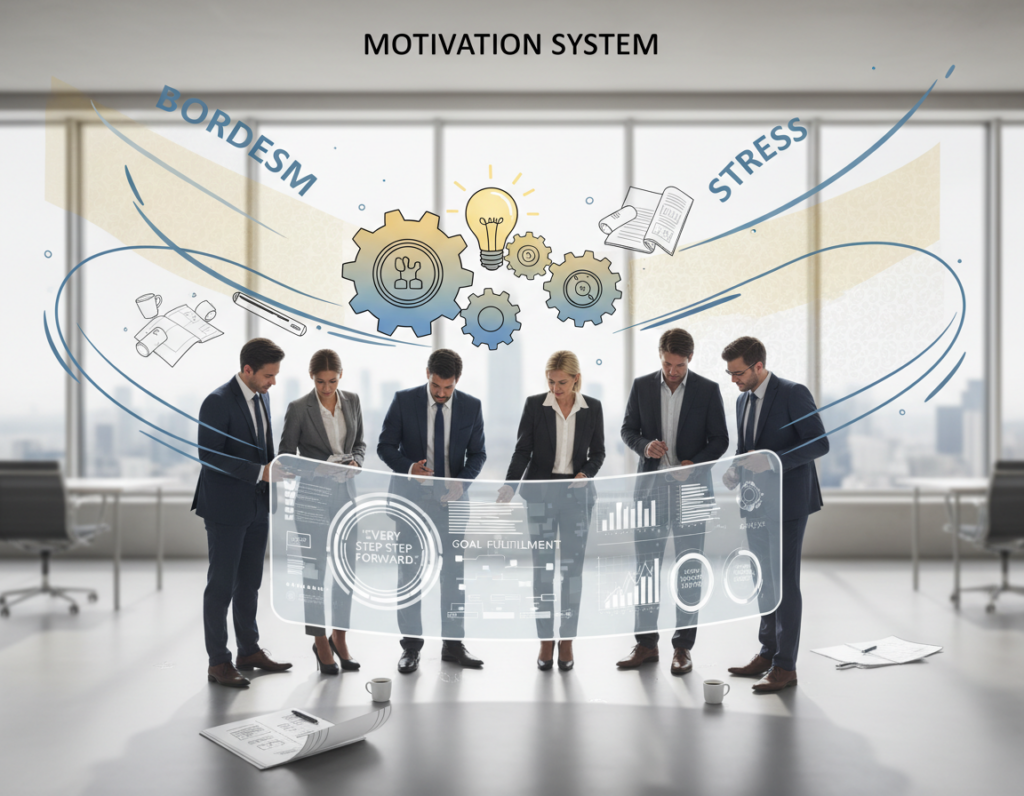
Building a motivation system that survives stress, boredom, and low willpower
A durable system beats rare bursts of willpower when stress or boredom appears. The aim is a stack that turns intent into routine and shortens the path from plan to action.
SMART goals and meaningful targets
SMART goals should be specific, measurable, achievable, relevant, and time-bound. Add a clear meaning line: why this goal matters to the individual. That link protects persistence when novelty fades.
Implementation intentions
Convert plans into if–then scripts. Example: If it is 7:30 a.m. on weekdays, then open the draft and write for 10 minutes. These cues raise activation and cut decision friction.
Systems over willpower
Design defaults and friction: prep the workspace, pre-commit time blocks, remove distractions, and automate reminders. Systems shift effort from choice to habit.
Accountability, community, and self-compassion
Make effort visible with weekly check-ins or a shared dashboard while letting the person choose the method. Pair accountability with self-compassion to reduce shame after slips.
“Short recovery beats long shame—it restores persistence faster than punishment.”
Measure what matters
Track activation (starts/week), persistence (sessions completed vs planned), intensity (focused minutes), and real outputs (deliverables shipped). Use these metrics to iterate the system.
For guidance on privacy and data practices tied to tracking, see the privacy and data practices.
Conclusion
Consistent achievement comes from designing systems that link needs, beliefs, and feedback into repeatable actions.
This conclusion rests on simple theory: discipline creates useful friction, drive reflects values and needs, and reward learning shapes craving and progress. Together they shape human behavior in measurable ways.
Next best step: pick one clear goal, run a brief expectancy and self‑determination audit, shrink the first step, then track activation, persistence, and intensity for 14–30 days. Use ethical, autonomy‑supportive rewards and build competence with gentle feedback.
Measure change, not feelings. Real improvement shows as more starts, longer streaks, and steadier focus across time. Treat motivation as a skill informed by psychology and trusted sources, revisited as life and context change.